





Nursing Career in New Zealand
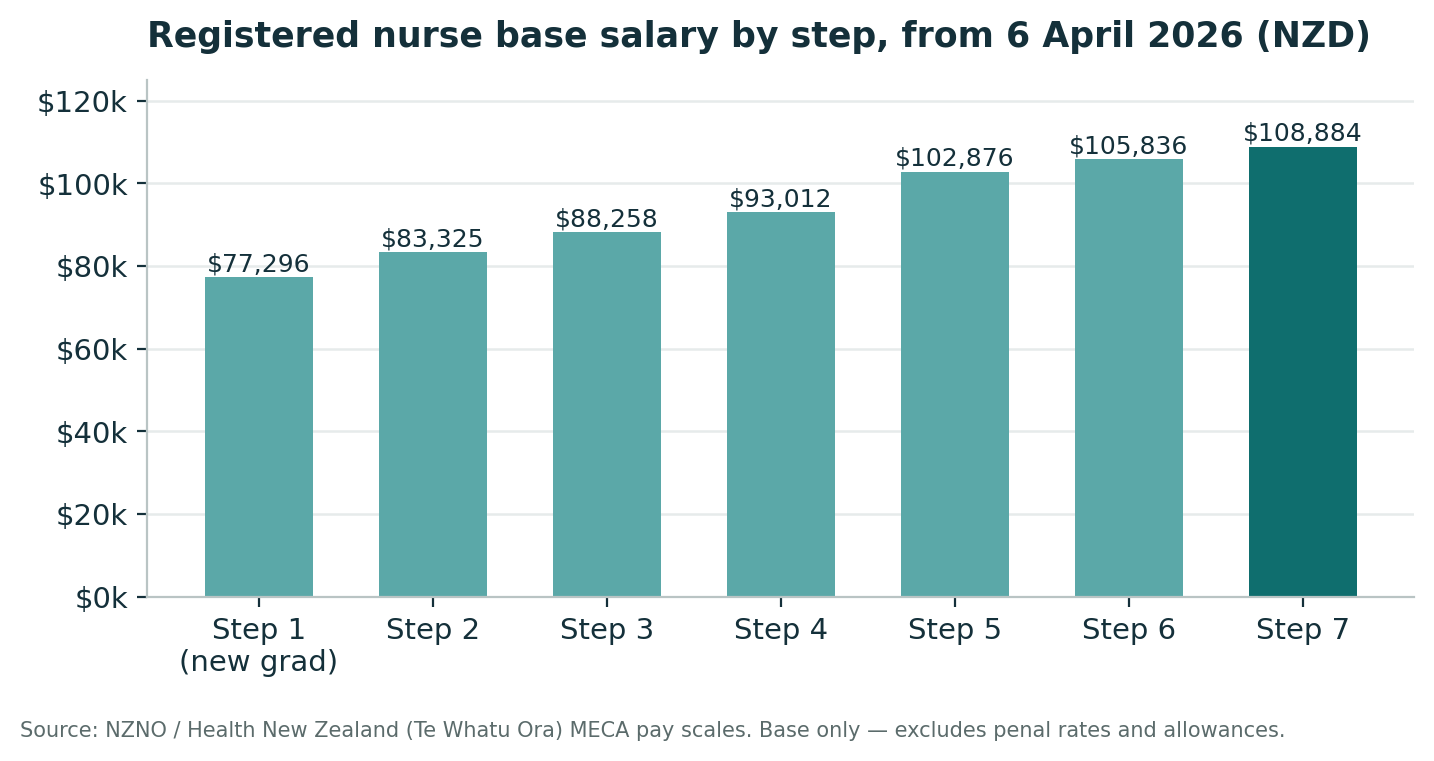
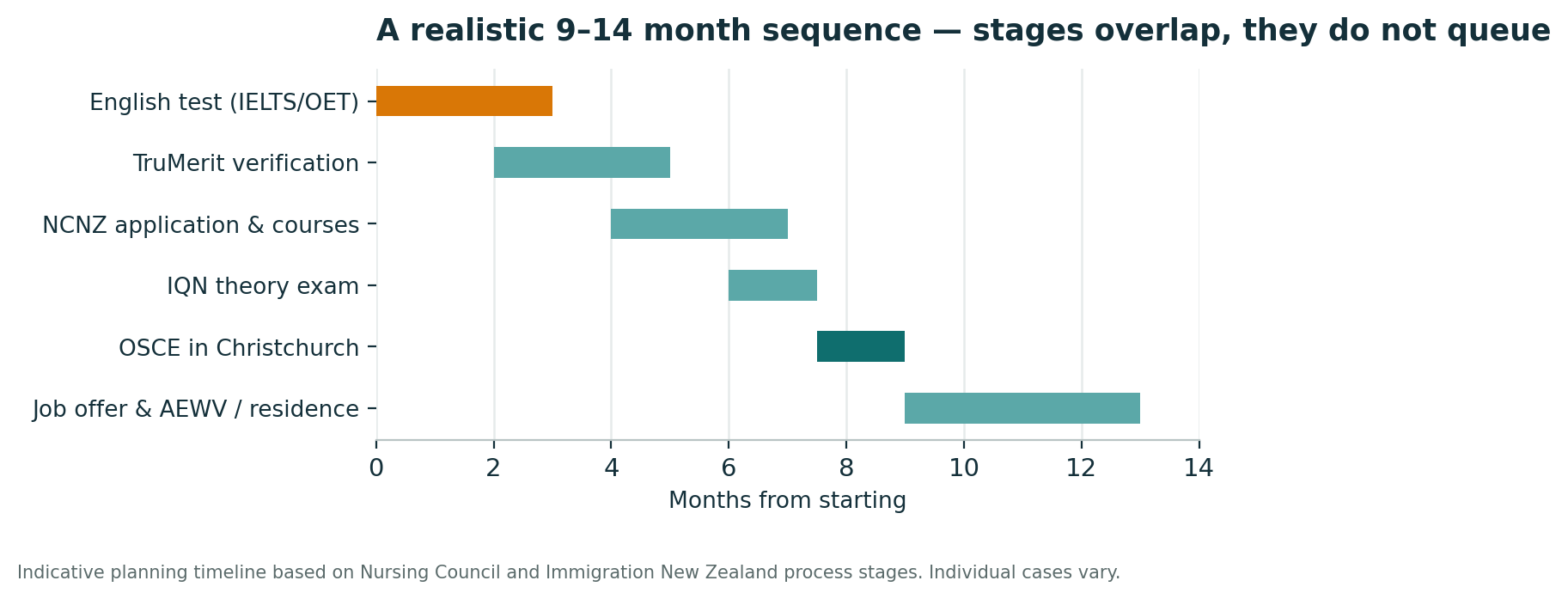
Registered nurses in New Zealand earn NZD $77,296 at Step 1 and $108,884 at Step 7 under the national MECA agreement, and Registered Nurse stands in Tier 1 of the Green List — the tier that allows a residence application straight away rather than after years of work. The gate is Nursing Council registration: TruMerit verification, IELTS Academic 7.0 or OET B, and for most internationally qualified nurses, a theory exam and an OSCE. Budget roughly NZD $4,940 and nine to fourteen months.
One thing most pages will not tell you: the market tightened after 2023. This guide gives you the verified numbers on both sides of that.
Why Does New Zealand Recruit Nurses From Overseas?
New Zealand's reliance on internationally qualified nurses is not marketing language — it is measurable, and the scale is unusual.
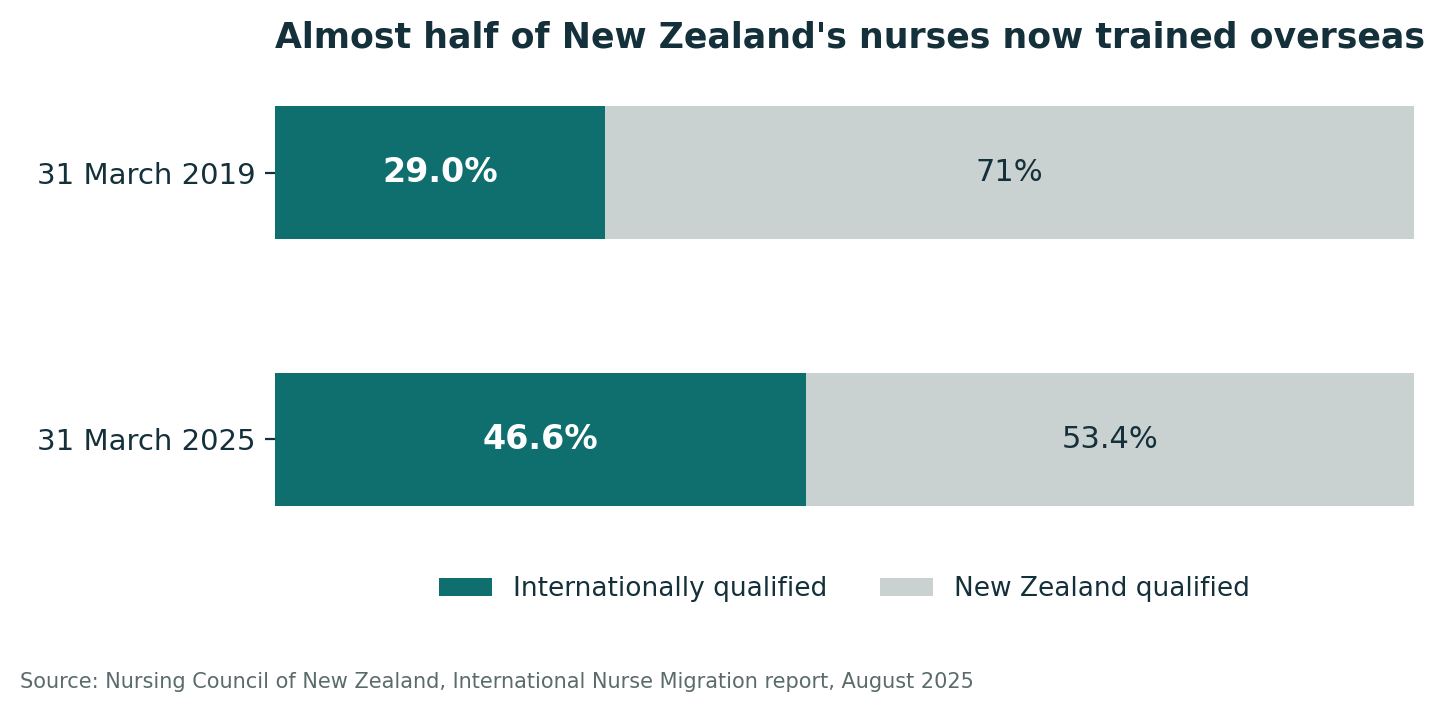
The Nursing Council's own August 2025 report records that 46.6% of nurses holding annual practising certificates were educated outside New Zealand, up from 29% in 2019. The same influx pulled the average nurse age down from 44.7 to 42.3 years. India is the single largest source country of internationally qualified nurses since the borders reopened in July 2022, ahead of the Philippines.
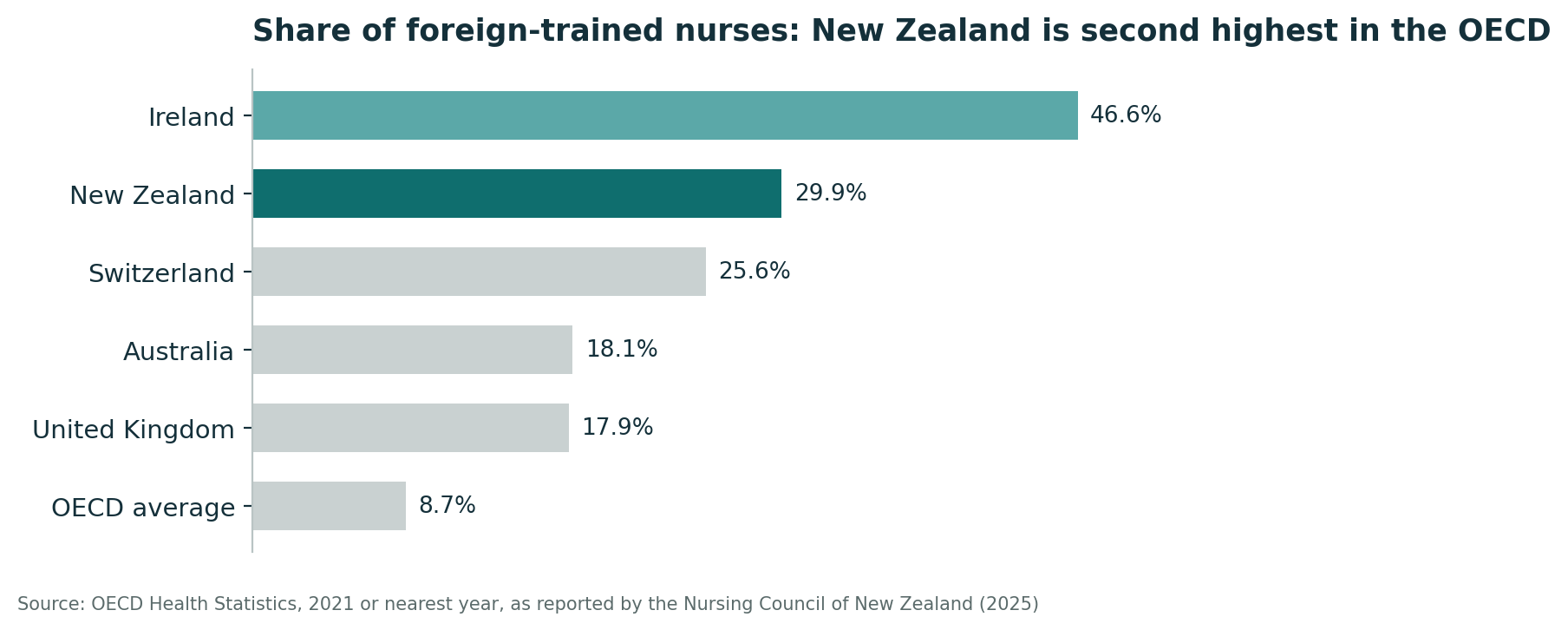
The honest part: the market is tighter than in 2023
Applications from overseas nurses peaked at around 7,000 in a single quarter in late 2023, and the Nursing Council states plainly that this produced an oversupply of nurses looking for work in New Zealand. Total nurses holding practising certificates then fell about 1% in the year to September 2025. Registration is still very achievable. A guaranteed job the week you land is not — plan for a search, and treat anyone promising otherwise with suspicion.
Who Can Apply?
- Current registration as a nurse with your home regulator, with verification from every authority you have registered with in the last 10 years.
- A nursing qualification the Council assesses as comparable to a New Zealand degree.
- 1,800 post-registration practice hours — reach this before you touch TruMerit, or the verification has to be redone.
- Recent clinical practice, normally within the last five years.
- English at IELTS Academic or OET level, plus a clean international criminal history check.
NCNZ Registration: The Current Route
Most advice online still describes the old Competence Assessment Programme — a supervised clinical placement of several weeks. Since December 2023, that has been replaced for most applicants by a two-part competence examination: an online theory exam taken at a Pearson VUE centre in your own country, then an OSCE in New Zealand. If a recruiter is still quoting CAP timelines, they are working from an old script.
- Hit 1,800 practice hours, then apply to TruMerit (formerly CGFNS) for document verification.
- IELTS Academic or OET — start this first; it has the longest lead time.
- Apply to NCNZ through the MyIQN portal with the NZD $485 application fee.
- Complete the free 'Welcome to Aotearoa New Zealand' courses on culturally safe practice and Te Tiriti o Waitangi, and your criminal history check through Fit2Work.
- Theory exam, then the OSCE at the Nurse Maude Simulation Centre in Christchurch, preceded by a short orientation course.
Nurses who trained in the UK, Ireland, the USA, Singapore, Ontario or British Columbia are assessed differently and may be exempt from the examinations. Everyone else should plan for both. Our full NCNZ registration guide sets out each document, each portal and what to do when the Council queries a file.
The English requirement that catches people out
IELTS Academic: 7.0 in reading, listening and speaking, and at least 6.5 in writing. OET: 350 in reading, listening and speaking, and 300 in writing. Scores can be combined across sittings, but the required marks must all be achieved within 12 months of your first attempt. The Council does not accept at-home or online test formats, and PTE is not accepted at all.
What Nurses Actually Earn?
Public hospital pay is not negotiated individually. It is fixed by the Multi-Employer Collective Agreement between the New Zealand Nurses Organisation and Health New Zealand, so an Auckland tertiary centre and a small Southland hospital pay the identical rate for the same step.
| Role | From 6 April 2026 (NZD) |
|---|---|
| Registered nurse, Step 1 (new graduate) | $77,296 |
| Registered nurse, Step 4 | $93,012 |
| Registered nurse, Step 7 (top of scale) | $108,884 |
| Designated senior nurse, Grades 1–6 | $116,317 – $166,074 |
| Nurse practitioner | $139,565 – $166,074 |
| Enrolled nurse, Steps 1–5 | $71,339 – $87,044 |
Two things the scale hides. Steps move with years of service, so documented overseas experience can lift your starting point — raise it at the offer stage, not after you sign. And most nurses on a rotating roster earn well above base once night, weekend and public holiday premiums are counted. Our nurse salary breakdown for New Zealand converts these figures to take-home after PAYE and ACC.
The honest comparison: Australia pays more. New Zealand's argument is the residence pathway, not the top-line number — which is exactly why the Council has flagged nurses using New Zealand as a stepping stone to Australia under the Trans-Tasman agreement.
Visa and Residence: What Tier 1 Means?
Immigration New Zealand places Registered Nurses in Tier 1 of the Green List, and nurses have been on the Straight to Residence pathway since December 2022.
| Requirement | Tier 1 – Straight to Residence | Tier 2 – Work to Residence |
|---|---|---|
| Applies to nurses? | Yes | No |
| Wait before applying | None | 24 months of NZ work |
| Employer | Must be INZ accredited | Must be INZ accredited |
| Registration | Must cover the exact role offered | Same |
| Age limit | 55 or younger at application | 55 or younger |
| Family | Partner and dependent children included | Included |
General registration is not enough where the role requires a listed speciality registration — check the job description against your scope before you accept. Many nurses arrive first on an Accredited Employer Work Visa while registration is completed, then apply for residence.
What It Costs and How Long It Takes?
| Item | Fee | Paid to |
|---|---|---|
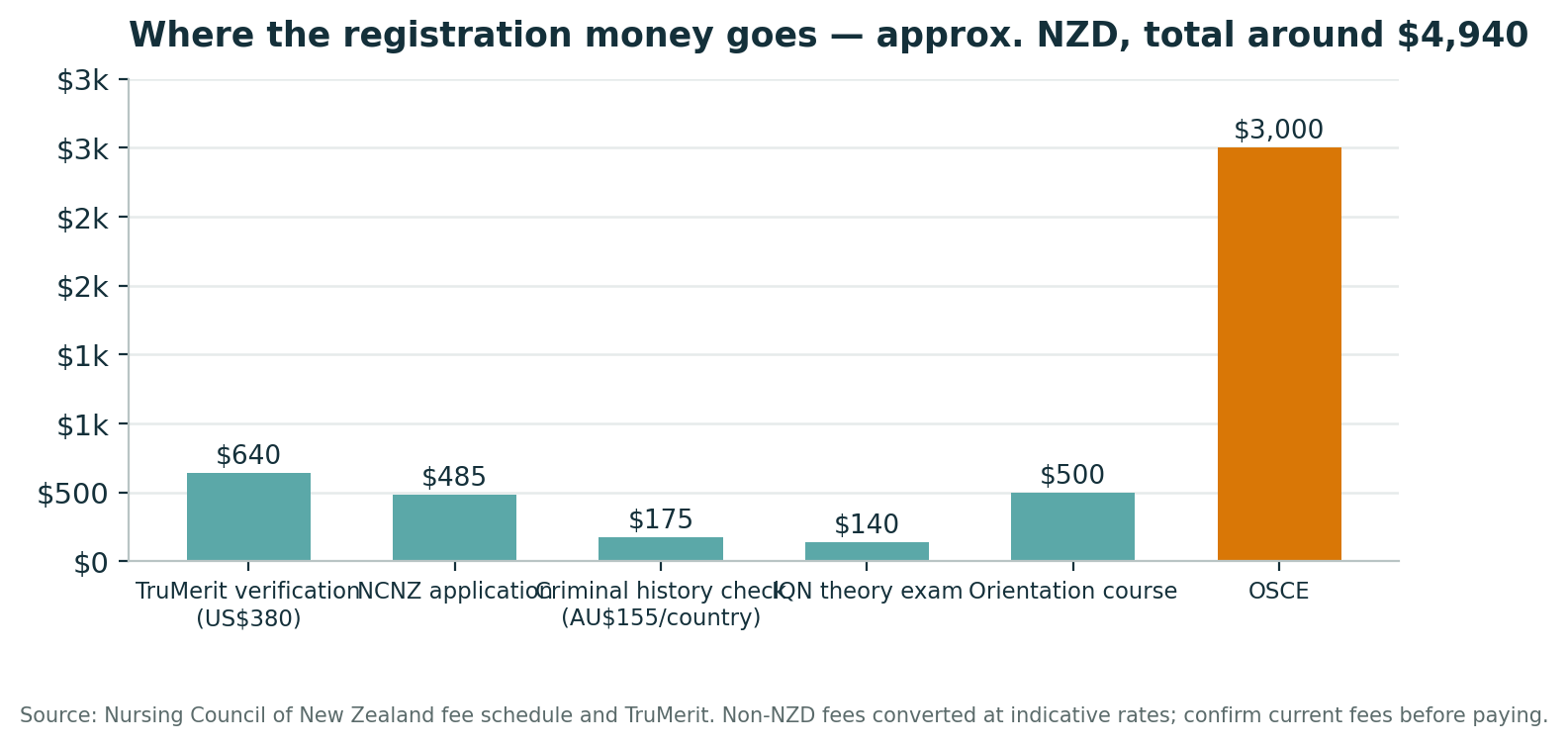
| Document verification | USD $380 | TruMerit (CGFNS) |
| NCNZ application and processing | NZD $485 | Nursing Council |
| International criminal history check | AUD $155 per country | Fit2Work |
| IQN theory exam (Parts A and B) | NZD $140 | Pearson VUE |
| Orientation and preparation course | NZD $500 | Nurse Maude, Christchurch |
| OSCE clinical examination | NZD $3,000 | Nurse Maude, Christchurch |
| Annual Practising Certificate | ~NZD $130 per year | Nursing Council |
Where to Work?
Because base pay is national, choosing a city is a decision about cost of living, case mix and competition — not salary. Start with what is advertised now on our live New Zealand nursing vacancies.
Auckland
A third of the country, the highest-acuity units and the national referral services — and the highest rents, commonly quoted around NZD $2,000–$2,800 a month for a one-bedroom. Most specialised opportunity, thinnest margin. Browse nursing jobs in Auckland to see what is open.
Christchurch
The South Island hub, rebuilt around a modern hospital campus, with housing well below Auckland levels. It is also where the OSCE is held, so many internationally qualified nurses already know the city before day one — see current nursing roles in Christchurch.
Regional and rural
Rural and hard-to-staff posts frequently add location premiums on top of MECA rates, sometimes with employer-arranged accommodation. If your priority is remitting money home, a regional role usually beats an Auckland one on net position.
Building a Career Once You Arrive
The step scale rewards continuous service, so staying put early pays literally. Beyond that, progression runs through part-funded postgraduate study into designated senior nurse grades ($116,317–$166,074) and nurse practitioner roles ($139,565–$166,074), a prescribing scope on its own scale. Aged care, primary health and community nursing are growing faster than acute hospital work and are often where internationally qualified nurses land first — a route in, not a lesser start.
Five Mistakes That Cost Nurses Six Months
- Applying to TruMerit before 1,800 hours. The most common avoidable delay of all.
- Leaving English until a job offer appears. Reverse that order — it is the longest lead time on the list.
- Booking an at-home or online English test. It will be rejected.
- Budgeting for the old CAP instead of the theory exam and OSCE.
- Paying an unlicensed agent. Check any Indian recruiter's MEA licence on emigrate.gov.in first.
Situation-specific questions are answered in our New Zealand nursing FAQ.
About Dynamic Health Staff
Dynamic Health Staff is the healthcare division of Dynamic Staffing Services, which began as a small setup in Mumbai in 1977, founded by Maj. S. P. Khosla after he retired from the Indian Army. The head office moved to New Delhi in 1982, and in 1983, Maj. Khosla co-wrote the Indian Emigration Act — the legislation that still governs licensed, ethical overseas recruitment from India.
The group operates from offices in Dubai, Abu Dhabi, Qatar, Bangladesh, Nepal and Pakistan, with 48 years in business, more than 480,000 placements across 24 countries and MEA recruiting agent licensing. The healthcare division was established in 2014, serving NHS hospitals and nursing homes in the UK and Ireland, and expanding to New Zealand, Australia and Poland in 2016. Over 4,500 nurses and 800 doctors have been placed internationally since then.
In New Zealand, our job is to get the order right — hours, verification, English, then the Council — and to tell you when the market is tighter than the brochures suggest. That is what decides whether your move takes ten months or two years.
Get in touch
Phone: +91 9810017608
Email: enquiry@dynamichealthstaff.com
Disclaimer: The salary mentioned in this article is indicative and may vary depending on the candidate's experience, interview performance, current salary bands, employer budget, job location, and other recruitment-related factors when applying through Dynamic Healthstaff.
Frequently Asked Questions
Is nursing on New Zealand's Green List?
Yes. Registered Nurse is Tier 1, which allows a Straight to Residence application with a job offer from an accredited employer.
What does a registered nurse earn?
From 6 April 2026, NZD $77,296 at Step 1, rising to $108,884 at Step 7, before penal rates.
What English score does NCNZ require?
IELTS Academic 7.0 in reading, listening and speaking with 6.5 in writing, or OET 350 in reading, listening and speaking and 300 in writing. PTE is not accepted.
What does registration cost in total?
Around NZD $4,940, of which the OSCE alone is $3,000. Re-registration is charged again in full.
How long does it take?
Nine to fourteen months typically. English testing and document verification take the largest share.
Do I still need a CAP?
Usually not. Most applicants now take an online theory exam and an OSCE in Christchurch instead.
How many clinical hours do I need?
1,800 post-registration practice hours before you apply to TruMerit.
Can my family come with me?
A partner and dependent children can be included in the same residence application.
Is it harder to find a job than it was?
Applications peaked in late 2023, and the Council recorded an oversupply of nurses seeking work. Plan for a genuine job search.
Which city should I choose?
Public pay is identical nationwide, so choose based on cost of living and case mix - Auckland for specialist depth, Christchurch or a regional centre to save more.