

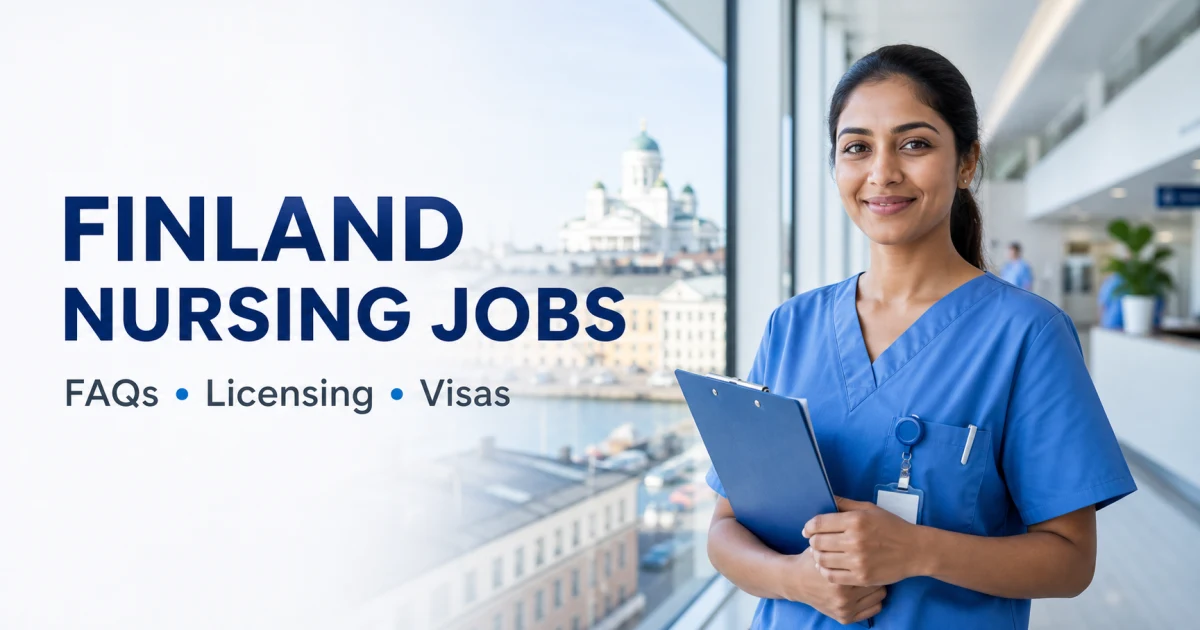

The healthcare system in Finland is well-organised, and working conditions are favourable. Public services are of good quality, and there are permanent jobs in the future. Nurses can also experience working in any field of healthcare in Europe.
Yes, Finland continues to need trained healthcare professionals because of an ageing population with growing care needs. The nursing shortage is clear in elderly nursing homes, home nursing, hospital wards, rehabilitation institutions, mental hospitals, and long-term care facilities.
Nurses may work with public hospitals, private clinics, health centres, elderly care homes, rehabilitation units, home care providers, mental health services, and specialist healthcare departments. Healthcare and social services are organised through wellbeing services counties across Finland.
If Indian nurses are willing to learn a language, get documents verified, assess their qualifications, go through licensing steps and maybe some bridging studies, they can look for nursing jobs in Finland. Preparation is required, but for the right candidates, Finland can offer a stable career path.
Proficiency in Finnish or Swedish is an important aspect of full nursing practice. Some Assistant or Transitional roles may take a lower language level whilst the candidate continues training, but regulated nursing roles require safe communication with patients and healthcare teams.
As a rule, credentials like a Bachelor of Science in Nursing or a General Nursing and Midwifery diploma should be obtained. However, candidates must acquire recognition of their existing qualifications in their countries.
A lot of employers do prefer hiring experienced nurses, and finding a good job in Finland will be a lot easier for them. Experience in elderly care, Intensive Care Unit, emergency unit, operation theatre, rehabilitation, psychiatric care, home care and long-term care may be needed to get hired.
The list of documents may include the credentials and transcripts from the university, a nursing certificate or license, work references, an identity card, and proof of language skills.
Yes, but they must follow the Finnish pathway. The Finnish Supervisory Agency grants the right to practise registered nursing to nurses trained in Finland and abroad. Only duly legalised professionals can perform legalised healthcare professional duties in Finland.
For nurses trained outside the EU or EEA, a comparative assessment may be required. Many candidates should expect bridging or top-up studies, which may cover Finnish healthcare law, patient safety, documentation, local clinical systems, and supervised practice.
The Finnish Supervisory Agency, known in Finnish as Lupa- ja valvontavirasto, grants the right to practise healthcare and social welfare professions in Finland. It now handles duties earlier associated with Valvira.
JulkiTerhikki/Terhikki is Finland’s professional register for healthcare professionals. Employers and authorities use it to verify whether a nurse has the right to practise in a regulated healthcare role.
Unfortunately, no. The duties of a nurse can only be performed after one is duly licensed. It is possible to engage in some other work as a nursing aide, assistant, or pre-licensure nurse in the meantime, depending on the employer’s requirements and based upon one’s qualifications.
It all depends on a number of factors, including correct documentation, qualifications, language requirements, requirements for training, etc. Candidates should bear in mind that this is a stage-wise process, which cannot be fast-tracked.
For current content, use Finnish Supervisory Agency or Lupa- ja valvontavirasto. Valvira can be mentioned only in context, such as “duties earlier handled by Valvira are now managed by the Finnish Supervisory Agency.”
Nurses must be proficient in either Finnish or Swedish. Your exact linguistic path depends on your target clinical role, specific employer requirements, and the nature of your license.
The National Certificate of Language Proficiency is an official testing system for language proficiency in Finland. It measures skills in Finnish, Swedish, or other languages needed for specific jobs.
Some assistant or transitional roles may accept a lower starting level, such as A2, while the candidate continues language training. However, candidates aiming for full nursing practice should plan for level 3–4 or the level required by the official pathway.
Yes, non-EU and non-EEA candidates need confirmed employment before applying for a residence permit for an employed person. Migri (the Finnish Immigration Service) states that this permit is mandatory for anyone coming to work for a Finnish employer.
Migri processes all residence permit applications. Candidates must choose the specific permit type that matches their job description and individual situation.
No, for an employed person’s residence permit, Migri states that you cannot start working before the permit is granted. You can work only in the field of employment for which the permit has been issued.
No. Employer support or visa documentation does not replace licensing, language, or qualification requirements. Nurses must still meet the professional pathway needed to work legally and safely in Finland.
Family members can apply for residence permits under the family-tie residence permit scheme. To be eligible, the main applicant must fulfil certain requirements, including fulfilling specific residency conditions, providing evidence of their income, and presenting relevant documentation.
Candidates are welcome to reach out to Dynamic Health Staff by submitting their updated CV along with the details of their nursing qualification, registration status, work experience, and language proficiency. Dynamic Health’s staff evaluates the profile and provides direction for the next steps.
Prepare your CV, passport, nursing certificates, transcripts, and proof of registration. Also, make sure to gather your experience letters and all evidence of previous training. Making sure these documents are accurate can help in avoiding delays.
Many international healthcare interviews are carried out online using video platforms. Employers may enquire about clinical experience, patient safety, communication, collaboration, documentation, ethics, and a desire to learn Finnish or Swedish.
Yes, Dynamic Health Staff assists the applicants in preparing their paperwork, making profile assessments, monitoring job offers, preparing for interviews, understanding the licensing procedure, and providing visa documentation assistance.
Application duration depends on the language preparation, paper preparation, employer interviews, qualification evaluation, bridging studies, obtaining a license, and getting a residence permit. The applicants must make plans and avoid applying at the last moment.
The life of nurses in Finland is organised and professional. They are to follow nursing plans, make records, have clear communication, respect patient safety, and act by their responsibilities.
The working hours may depend on their employer, position, agreement, and shift model. They may work at different times: morning, evening, night, and so on, according to the needs of the department.
Finland is usually associated with safety, provision of public services, cleanliness, and high living standards; however, it is worth mentioning that climate and other peculiarities should be considered before coming there.
Helsinki, Espoo, Turku, Oulu, and Tampere are the places where there are lots of hospitals, elderly care centres, rehabilitation facilities, and home care centres.
Nurses need to understand the gross and net wages, taxes, transport, climate, working characteristics, as they prepare for their relocation and the process.
Nurse salaries in Finland can vary by job title, years of experience, employer, geographic location, language skills, education level, shift type, and more.
There are many different forms of employment with shift rotation; thus, various compensation for night shift work, weekends, holidays, and so on may apply depending on the contract conditions.
Indian nurses in Finland stand a good chance of achieving success in their careers, but their success largely depends on their ability to learn the language, eligibility for the licenses, experience in Finland, and their training performance.
Some jobs are permanent, and some are temporary, based on the employer and type of contract. Therefore, candidates should examine the offer letter properly.
Yes, nursing experience in Finland can boost a nurse’s credentials internationally. It demonstrates proficiency in European standards of care, nursing documentation, patient safety, and work in a multicultural setting.
There is no definite time that one takes to become a registered nurse in Finland. Various factors such as the number of languages one knows, legal processes one has to go through, degree recognition and bridging studies have to be factored in.
Language preparation length may vary depending on one’s initial proficiency level and learning commitment. Achieving YKI level 3 or level 4 takes time, especially for people starting from the beginner level.
One should always start preparing documents well in advance. Being too late to prepare important documents like transcripts, application forms, work experience letters, etc. could hinder the completion of the application process.
The job offer must be made to you before the submission of the application by non-EU or non-EEA applicants. They must also have all the documents required for the application.
Dynamic Health Staff will assist candidates with regard to profile evaluation, document requirements, interview preparation, employer coordination, licensing pathway information, visa documents, relocation support, etc.


Request Talent/Request Meeting/Request Advice/Others
Contact Us OR For more details, please mail to
Great organization require great talent. Tell us about your recruitment issues and allow us to help.